

As organisations generate massive volumes of data from cloud platforms, applications, IoT devices and digital transactions, traditional data architectures are being pushed to their limits. Businesses are now evaluating modern solutions such as data lakehouses to handle advanced analytics, artificial intelligence and real-time insights. Understanding the difference between a data warehouse and a data lakehouse is critical for building a scalable data strategy in 2026.
For many years, data warehouses have been the backbone of enterprise reporting and business intelligence. However, with the rise of big data and AI-driven analytics, organisations need platforms that support structured and unstructured data while maintaining performance, governance and flexibility.
Understanding Data Warehouses
A data warehouse is a structured repository designed for analytics and reporting. It stores processed data from multiple systems and enables organisations to generate insights through dashboards, reporting tools and business intelligence platforms.
Traditional data warehouses such as Azure Synapse, Snowflake and Amazon Redshift are optimised for structured data and SQL-based analytics. They deliver high-performance queries and reliable reporting but may struggle with large volumes of unstructured data used in modern AI and machine learning workloads.
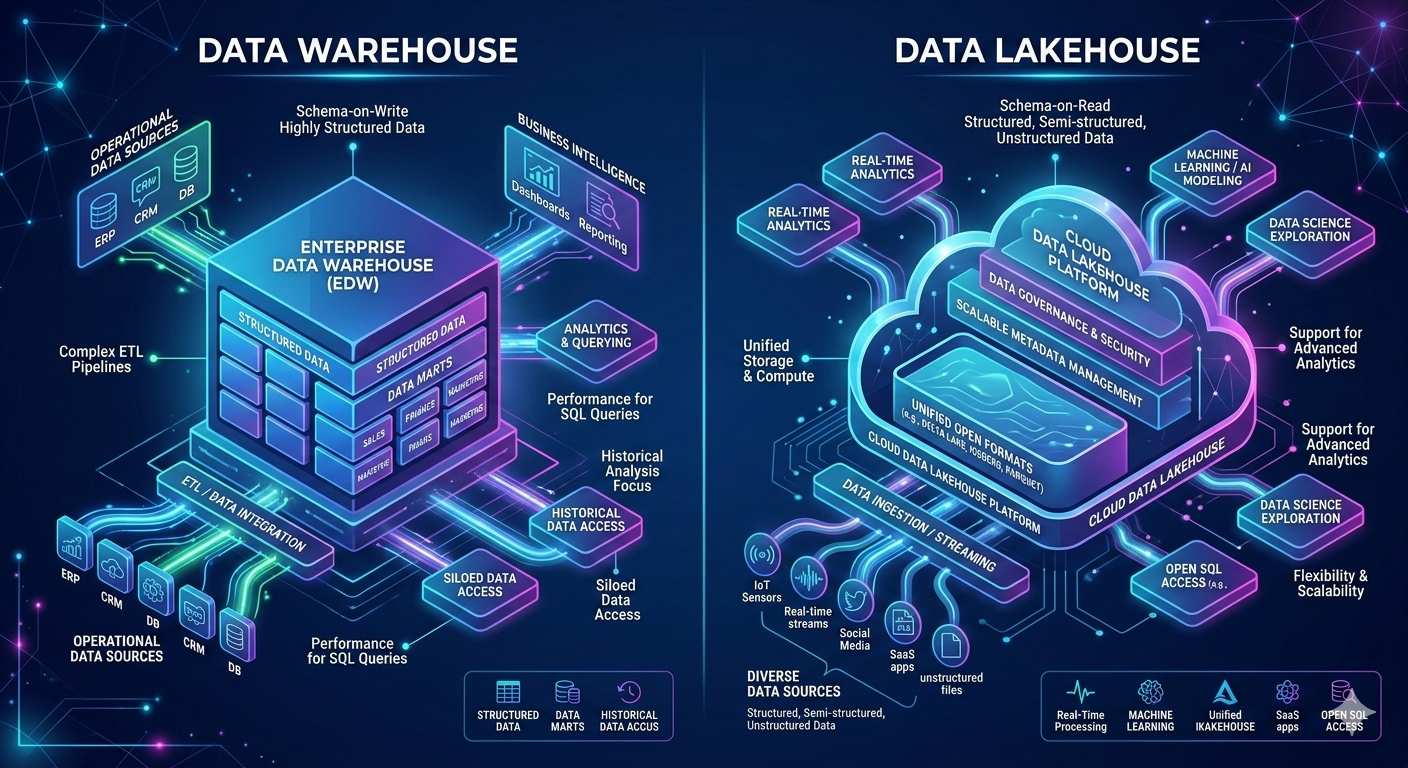
Data warehouses remain essential for structured reporting and enterprise dashboards. They provide reliable governance, security and data consistency across departments such as finance, sales and operations.
However, organisations today require more flexible platforms capable of handling streaming data, AI models and advanced analytics. This is where modern architectures like the data lakehouse are transforming enterprise data strategies.
The data lakehouse architecture combines the strengths of both data lakes and data warehouses. It allows organisations to store raw data at scale while also enabling structured analytics, governance and high-performance queries.
Platforms such as Databricks Lakehouse and Microsoft Fabric are leading this transformation by providing a unified data platform that supports analytics, artificial intelligence and machine learning within a single architecture.
Modern data platforms must support both analytics and AI workloads while maintaining governance, scalability and performance.
Enterprise Data Architecture Principles
By combining the flexibility of data lakes with the performance of data warehouses, lakehouse platforms enable organisations to simplify their infrastructure while unlocking deeper insights from enterprise data.
Businesses adopting lakehouse architectures benefit from improved collaboration between data engineers, analysts and data scientists. Teams can access a unified data platform that supports real-time analytics, predictive modelling and enterprise reporting.
The Future of Enterprise Data Platforms
As organisations continue to adopt AI-driven decision making and advanced analytics, modern data architectures must evolve. The data lakehouse model provides the flexibility, performance and governance required to support the next generation of enterprise applications.
For organisations building modern data platforms in 2026 and beyond, lakehouse architectures represent a powerful foundation for analytics, artificial intelligence and enterprise data governance. By adopting the right data architecture strategy, businesses can transform raw data into meaningful insights that drive innovation and smarter decision-making.